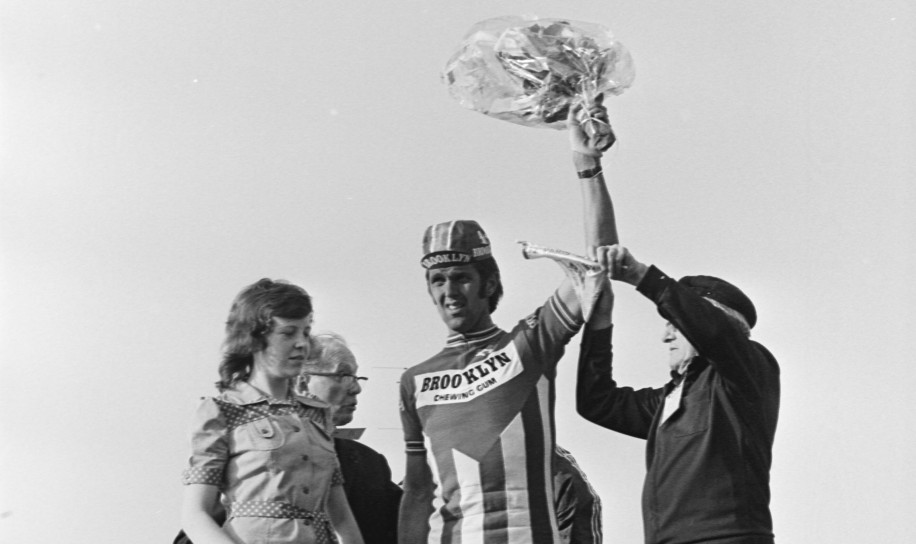
As a young cyclist, Pierrot De Wit was a regular at the Schaarbeek velodrome. On numerous occasions De Wit demonstrated his ability there and developed into a very solid athlete. Until a chance encounter set him on a different path.
“At one point – it must have been sometime in the mid-1950s – I was hanging about near the changing rooms where the riders always sat after a race. I was at the changing room where Gust Naessens, the soigneur, was supposed to be, but he wasn’t there. Just then, the Swiss rider Hugo Koblet and Armin von Büren walked past. They asked for Gust, but he’d gone.”
“They then asked if I could look after them a bit. Of course. It really wasn’t much more than providing some food and drink. And afterwards they asked me how much they owed me. They each paid me 500 francs! That was a lot of money. They also gave me the trophy from their victory. I knew straight away that there was good money to be made in looking after riders."
Not long after, the Spanish stayer specialist Guillermo Timoner asked Pierrot if he would look after him at a track meeting in Antwerp: “At the time, I hadn't made my name as a soigneur yet, but he asked me anyway. Afterwards, he said to me: ‘Mais, tu masse très bien toi, petit.’ ("But you give a very good massage, kid") I continued to look after him for years afterwards and eventually became world champion with him six times.”
On the track, De Wit also came into contact with André Darrigade. The French star – “he was the first champion I worked for” – was so satisfied with Pierrot’s work that he helped him secure a contract as a permanent soigneur with the Alcyon team, where Darrigade was the star of the show.
Mais, tu masse très bien toi, petit.
To further hone his skills as a team physio, he not only observed closely but also learnt a great deal from veterans such as the Belgian soigneur Louis Guerlache and his French colleague Julien Schram. At the same time, Pierrot also undertook specialised training at the Andrews Institute in Brussels. In the spring of 1960, he was officially recognised as a qualified masseur.
A year later, he was working alongside the German stayer Karl-Heinz Marsell, who went on to become world champion that year. “The way that man rode behind a motorbike. Unbelievable! But I won’t forget that World Championship with him in a hurry,” says De Wit. “Three hours before the final, he was sitting in a restaurant having a meal with a big pint of beer next to him. I feared the worst, but Marsell outclassed the opposition and won.”
After three world titles with Timoner (1955, 1959, 1960), a fourth rainbow jersey on the track, with Pierrot’s help, became a reality.
De Wit worked as a domestique for Darrigade and the Alcyon team, also competing in various stage races. But his heart lay with the velodrome. “It didn’t happen very often in my career that I signed a contract with a team for the road season. I preferred to be paid on a performance basis. And even back then, my preference was for the track.”
On the track, he became associated with a number of Italian stars in the 1960s. Antonio Maspes, who was crowned world sprint champion seven times between 1955 and 1964, was one of them. “Every year, two weeks before the World Sprint Championships, Maspes would have me come over to his house in Milan.”
“That was also the case at other major meetings. I was allowed to stay with him and received a good fee. Maspes was a class act. In my first year working with him, he not only became world champion but also Italian champion, and he won the prestigious Grand Prix de Paris.”
In the run-up to the 1963 World Sprint Championships, the relationship between Maspes and De Wit (briefly) soured. Rival Sante Gaiardoni took advantage of this and signed Pierrot. It proved a successful move, as it was Gaiardoni – not Maspes – who became world champion that year.
In Italy, Pierrot was held in high esteem. This was also evident when pursuit specialist Leandro Faggin approached the Belgian team physio. Pierrot enjoyed working with Italian track cyclists: “Back then, the Italians were truly top-class. What’s more, they paid very well.”
By the second half of the 1960s, the name Pierrot De Wit had become a household name in the cycling world. That did not prevent De Wit from working exclusively with top riders. The French track cyclist Jacky Mourioux found this out for himself during the 1967 Berlin Six-Day Race.
“Together with Alain Van Lancker, I took part in a Six-Day race for the first time back then. We didn’t do too badly, and afterwards Pierrot came over to us. He was pretty much the only person who spoke French, so we were absolutely delighted that he did. Incidentally, Patrick Sercu was riding there with the pros and was the only rider who came to congratulate us on our performance. He was being looked after by Pierrot.”
A strong bond developed between the Mourioux-Van Lancker duo and Pierrot. Mourioux: “Fortunately, because he played a very important role in my career. He must have already seen in Berlin that we had potential.”
For Mourioux, Pierrot’s qualities are clear: “He was very good at motivating us. ‘Le moral, c’est primordial,’ he always said. What’s more, he was always up for a laugh – that was just his personality. That wasn’t the case with many other soigneurs. Both Alain and I were proud to be able to work with Pierrot.”
In those days, Patrick Sercu was the star of the velodrome and – unsurprisingly – often worked alongside Pierrot. During 1969, Pierrot also counted Eddy Merckx amongst his clients.
“I had my own practice here in Etterbeek, where both professionals and young riders would come. After Merckx’s serious crash on the trackt at Blois, I started working with him too. Whenever Eddy was in the country, he’d come to my house up to three times a week. All those young riders would stare at him in awe every time!”
The first person to ring me on my birthday is Eddy, at 8 o’clock in the morning. Bonne anniversaire Pierrot!
Pierrot remained by Eddy’s side until his retirement in 1978. Merckx’s retirement, however, did not mark the end of the close bond between the two Brussels natives. Pierrot joined Eddy’s cycling club, which also included many of his former team-mates. Pierrot and Eddy even regularly formed a one-off duo at the annual Gentlemen Duo Classic in Sint-Pieters-Leeuw, an event organised by Andy and Freddy Missotten and the non-profit organisation Cycli Prom.
According to De Wit, the bond remains strong to this day. “The first person to ring me on my birthday is Eddy, at 8 o’clock in the morning. ‘Bonne anniversaire Pierrot!’” He also got on very well with Sercu: “When Patrick decided to stop racing, he came to see me. With a large box full of jerseys. As a thank you for all my work. Both Patrick and Eddy meant a great deal to me. I’m proud to have looked after the two best riders in the world, each in their own field.”
The list of cyclists Pierrot worked with is particularly extensive. Father and son Wiggins, separated by several decades, for example. But also Luis Ocana, Roger Rosiers, Peter Post, Urs Freuler and Stan Tourné. Or Tony Doyle, whom Pierrot even regarded as a second son and whose untimely death caused Pierrot great pain.
Alain Bondue, the French world pursuit champion in 1981 and 1982, was a rival of Doyle’s and worked with his own soigneur: “You couldn’t be the masseur for both Doyle and Bondue. That just wasn’t possible. But I often saw Pierrot at work. He was always full of energy, dynamic and always with a smile on his face.”
Jean-Luc Molineris, who often saw Pierrot at work as a team-mate of Merckx, agrees. “He was a true professional. A brilliant soigneur. Whatever happened, he stayed true to himself. You know, it’s difficult to describe Pierrot; he’s a unique personality. To me, he’s even a legend. I’d best describe him as the Merckx of the support staff.”
9 June 1945. Luis Ocaña is born. The eccentric rider is still known as the challenger to Eddy Merckx in the Tour. His palmares include two overall...